Archives: Portfolio

  • Websites and digital media libraries

    Design, development and publication of websites for associations, institutions and artists.
    Coordination of website redesigns, development of specialised tools, specifically for projects aimed at showcasing archives and digital collections.

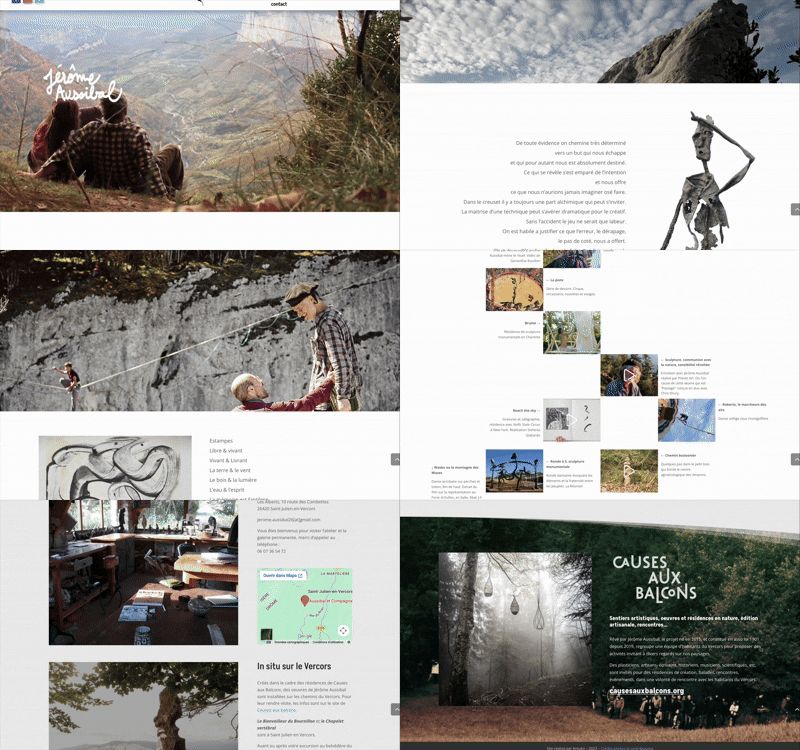
    aussibal.com

    Website for the performer and visual artist Jérôme Aussibal.
    Compilation of his performance company’s archives, portfolios, editing of a showreel, and creation of a ‘one-page’ design reflecting the artist’s creative world.
    Showcasing past projects in the form of a journey along a trail of thumbnails.

    Landing screen
    Scroll down

    aussibal.com

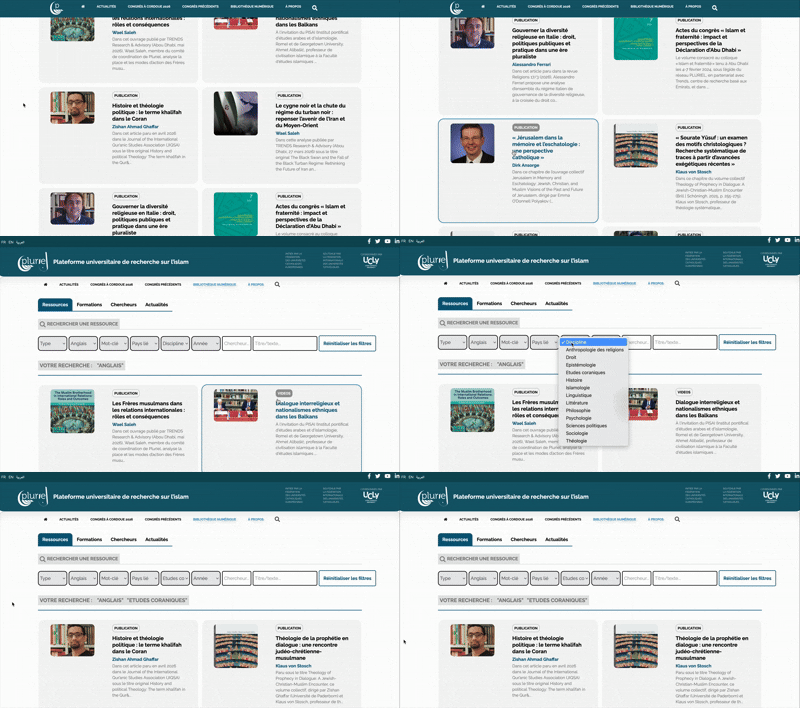
    Pluriel.Fuce.Eu

    Website of the Pluriel network: University Platform for Research on Islam in Europe and Lebanon
    Overseeing the redesign of the website from a showcase version to a digital resources portal.
    Coordination with the developer, harmonisation of metadata and indexing of resources, interactive map of network members, homepage with dynamic content.

    Pluriel Network Digital Library

    pluriel.fuce.eu

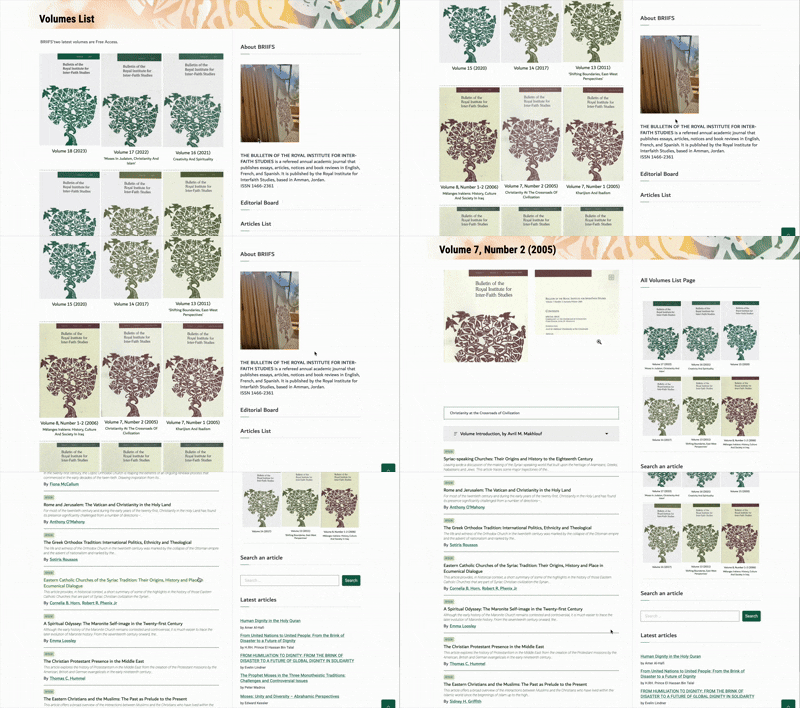
    Briifs.riifs.org

    Website of the international scientific journal of the Royal Institute for Interfaith Studies, in Amman, Jordan
    Produced as part of a project to promote the research centre’s scientific archives.
    Implementation of a process to digitise articles published between 1999 and 2022, layout of PDF and web versions, development of the library with subscriber access and technical documentation.

    Digital archives of the journal BRIIFS

    briifs.riifs.org

  • Museum films

    At the intersection of research and creativity, museum films require a particular approach to storytelling. Often designed to be shown continuously, they aim to captivate the viewer’s attention whilst presenting scientific content.
    These films involve filming interviews, capturing illustrative footage and, at times, staging scenes; conducting iconographic research in archive collections; editing and designing graphics in keeping with the exhibition’s style; writing and recording voice-overs; structuring the film into chapters; and, of course, maintaining constant coordination with the client and the project’s scientific advisors.

    Routes en Guerre

    Docudrama, 22 minutes, co-director, editor

    Directed by Kamea Meah Films, written by Pierre-Louis Fillet, director of the Departmental Museum of the Resistance in Vassieux-en-Vercors, and co-directed by Nathanaël Coste and Antoine Meyer.
    Drawing on the expert insights of Philippe Hanus, Gilles Vergnon, Céline Dumas and Pierre-Louis Fillet, the film tells the story – through the voice of a young girl whose father was a member of the Resistance – of the uses and challenges associated with the spectacular roads of the Vercors plateau during the Resistance.
    The documentary was screened at the museum as part of the temporary exhibition ‘Roads at War! Vercors and Mobility 1939–1945’, which ran from September 2020 to December 2021.

    Chemin(s) faisant

    3 video clips for an exhibition, co-director, editor

    These short videos explore, in three parts and using expert commentary, illustrations and map animations, the unique characteristics of the Vercors massif, the historic routes through the region, the construction of the first roads, and the challenges associated with them.

    Produced for the Drôme Departmental Archives and the Heritage Conservation Department, the videos were screened during the exhibition *Chemin(s) faisant: A History of the Roads of the Vercors* and published on the website of the virtual exhibition.

  • Ego not bad

    Documentary film, 26 min, 2015 (co-director and editor)


    “Ego Not Bad” – these three little words, taken together, don’t sound like anything particularly positive. And yet, it’s all in how they’re put together! These surprising words come from an Indian yoga master, Surender Singh, who is trying to tell us that, contrary to its bad reputation in the world of spirituality, the concept of the ego is not something to be fought against.
    This short film, based on the final interview with Arnaud Desjardins (filmmaker and spiritual guide), is intended as a brief guide for anyone embarking on an inner journey. What are we seeking on spiritual paths? What pitfalls should we avoid?

    Co-directed with Nathanaël Coste and Marc de la Ménardière, this film was made alongside the feature-length documentary En Quête de Sens, the story of two childhood friends who decided to travel around the world to meet philosophers, farmers, scientists and shamans in search of answers to their questions: How did Western civilisation end up in this state, and where should we start to bring about change?

    Produced by Kamea Meah Films via a crowdfunding campaign

  • Larsen video

    Two experimental videos based on the use of ‘video larsen’ material. Created using analogue techniques by filming a point of light on the edge of a screen displaying that point of light, video larsen produces an ‘organic’ animation of geometric shapes that are strikingly reminiscent of certain traditional patterns, but also of the visions described by those who have experienced altered states of consciousness – shamanic experiences featuring the tree of life, the cosmic serpent.
    Both videos explore movement and stillness, seeking to express the invisible vibration that lies at the source of an ecstatic state, and which the body’s posture expresses only partially, and only in its very external manner.

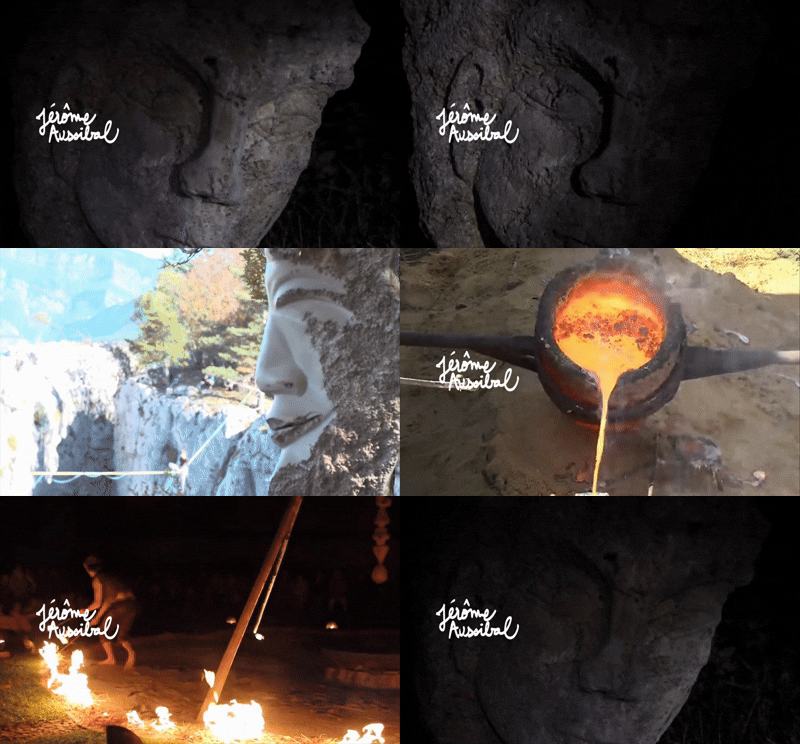
    Semâ

    2011
    The cosmic dance of the whirling dervishes, in which bodies spin like atoms or planets, to forget the human self, to annihilate the physical form, leaving only the longing for God. The superimposed video larsen material illustrates bodies that are now nothing but vibrations.
    Audio: Ceremony of remembrance of God (zikr) with a Sufi master of the Chisthya brotherhood, recorded in Konya, Turkey
    Images: Semâ, the ritual dance of the whirling dervishes. Filmed in Konya, Turkey

    Pins and needles

    2008
    The ‘pins and needles’ sensation in numb limbs, the inner dizziness when the mind overwhelms the body, or the intense vibration induced by hyperventilation techniques (rebirthing).
    Audio: reading of Albert Camus’s *L'Etranger*.
    Images: staging for the installation *Ce qui s’échappe touche du ciel*, Cie Dirada, Théâtre de lune, Lyon

  • The Mahdaleh of Qartaba

    Documentary film, 33 min, 2015

    An ethnographic study of the dry ablution ritual using the stone known as the ‘mahdaleh’ in the village of Qartaba, in Mount Lebanon.
    An approach based on sketching allowing for a variety of approaches to the same subject.
    Produced as part of a visual anthropology seminar run by the Ethnoart association in partnership with the Lebanese Academy of Fine Arts in Beirut.

  • Earth-to-Earth Encounters

    Reportage – expérimental – 21 min, 2011

    Le nom du groupe lyonnais Antiquarks s’inspire de la physique atomique pour souligner la nécessité d’aller vers l’Autre, vers celui qui parait pourtant si différent, opposé. Ainsi sa musique colore les cycles lancinants d’une vielle à roue électrisée avec les voix aux accents parfois inventés par son percussionniste. Un voyage irrésistible, une musique de l’interterrestre comme Antiquarks se définit lui-même. Et voilà qu’en 2011, une étrange invitation est faite au groupe, formé en trio pour l’occasion. Ce film témoigne de ces rencontres en prenant le temps, en cherchant à capturer, par sa duoscopie, un « en même temps », qui se joue dans les regards, les hésitations, le décor percutant, de ces rencontres exceptionnelles.

    Production : Coin Coin Productions, Centre Culturel Français d’Achgabat

  • Barzakh

    Video creation for theater performance, Lebanon, 2015

    برزخ / Barzakh, is a term used to signify a barrier between two things, such as the time interval between life and the life of the hereafter, from death to resurrection: He who dies, enters the isthmus, where space and time vanish away. Man finds himself overwhelmed with questions centered around the idea of existence, creation and the end of life, or death; time and how to define it. Man is born and he goes through different experiences that begin and end, while time remains the sole constant that never stops when the human heart stops beating. 

    The scenario is based on a true incident when the actress, Roua Bezeia, experienced the moving from one phase of time phase to another, due to a car accident that nearly cost her her life, when her heart stopped for 35 minutes and she had to undergo a cardiopulmonary resuscitation.

    This creation was shown numerous times in Lebanon, and was selected at Kampala International Theater Festival (Uganda), and Umumbunta Festival (Kigali, Rwanda).

    Minwal Theater Company

    Directed by: Jad Hakawati
    Performance by: Roaa Bzeih
    Video: Antoine Meyer
    Scenography: Jad Hakawati
    Light: Hagob Dergogasian
    Sound and Music: Rabi’e Salama and Sari Moussa


  • A window on Gaza

    Video Installation – 7 min, 2025

    Part of the exhibition ‘Gaza: Arab Gateway to the Sea, Memory and Art’ in Amman, Jordan, under the patronage of His Royal Highness Prince El Hassan bin Talal.

    Dominican friars Jean-Michel Humbert and Jean-Baptiste de Tarragon entrusted me with fragments of raw video footage, shot by filmmaker friends who visited them during their archaeological work in Gaza. I searched within these images for what Gaza reveals of itself: the sea, small shops—mostly closed as the camera passes—then the sea again, the rooftops of the city… and little human presence. So I began to give special attention to the people—a passer-by, a driver—lingering on them. Where are they going? Who are they? Where are they today? This experimental edit functions as a window onto Gaza, blending traces of memories lived by visitors passing briefly through.

    Conçu pour une diffusion/ projection à 2 écrans juxtaposés
    Images :
    Serge Nègre, 2017
    Dominique Cabaret, 2021
    Musique :
    TV Troupe for Music & Palestinian Heritage, Gaza
    Ad Vitam Records, 2006

    « A moving and reflective piece that adds depth to the narrative of Gaza. Your lens gently reminds us of presence, memory, and continuity. Thank you for being part of this journey. » Friends of Jordan Festivals

  • Where has the sacred gone ?

    Série documentaire sonore – 6 épisodes
    Diffusé sur borne d’écoute dans la cadre du parcours d’art Sillon (Drôme) / Diffusé sur Radio Saint Ferréol

    Avec le recul de la pratique des rites religieux, un mouvement régulier de l’homme est-il en train de disparaître de son comportement ? Le mouvement qui va de l’espace/temps profane vers un espace/temps sacré. Cette série est une enquête sur la perception du sacré par les habitants du val de Drôme. Elle cherche à identifier où et quand le sacré est encore vécu, parfois sans le nommer.

    Episode 1 : Nizar et Bernard / Musique : Matthieu Chevalet
    Episode 2 : Chez les maraîchers / Musique : Sam Maher : www.masterthehandpan.com/
    Episode 3 : Jonathan / Musique : Mathieu Valette alias ValMat : @valmatmusicat
    Episode 4 : Aux vendanges / Musique : Yohann Recoules alias L’évadé
    Episode 5 : Vigi-prière / Musique : Yohann Recoules
    Episode 6 : Yves et ses piereqs / Musique : Yohann Recoules et Yves Tallon

    Be a Soccer Ball Script

    Photo : Yves et ses installations en pierre (écouter l’épisode 6)

  • The street awakeners of Amman

    Field research in religious studies, sound recording, 2026
    Paper presented at the symposium ‘A Generation On – New Theories, Methodologies, Spatial Inquiries, and Research Directions with SWANA Youth’, organised by IFPO / MMU, May 2026

    Abstract
    Based on a fieldwork conducted in Amman in 2024, this contribution explores a ritual well known across SWANA but little studied by the academic literature. Despite obvious competition from alarm clocks and mobile phones, street drummers or ‘awakeners’ (known as _musaharati_ in Arabic) continue to shape the soundscape of Ramadan nights in many cities of Islamic culture. Alone or with a few colleagues, the _musaharati_ roam the streets of a neighborhood beating a drum and chanting formulas to wake residents for the _suhoor_ meal, before dawn. Our study aims to identify the dynamics of the practice in Amman's downtown neighborhoods and the reasons for its resistance to modernity. It brings together the ethnographic observations during the nights of Ramadan, interviews with _musaharatis_, survey results and an analysis of online comments.

    Matériau sonore collecté
    Différents type de « recitations », plus ou moins chantées,
    Bruits exprimants le contexte de la déambulations nocturnes, chiens aboyants, résidents interpellants, alarmes de voitures déclenchées.

    This research outlines the differences between elder and young practitioners, but also, in a diachronic approach, how the ritual is performed today and how it was in the past. Our findings show a non-regulated and pluralistic practice generally appreciated by the residents. While more young people embrace this seasonal self-employed role than in the past, they also participate in its reconfiguration. Changes include greater mobility between home and performance sites, greater anonymity, territories delimited by sound range to save time, gathering in groups, and varying levels of religious devotion among practitioners. It then appears that the aspiration for a space and time of freedom may be a key motivator, surpassing the desire to preserve tradition, seek financial gain or contribute socially or spiritually. Exploring the category of youth by the entry of their participation to this ritual offers a panorama of different situations faced by Amman's youth, even within the same disadvantaged community. It also questions the capacity of the younger generation to seize the opportunity of a para-religious tradition to create spaces of relief and transgression amid various pressures, from the struggles of daily life and structural unemployment to the restriction on expression of solidarity with Gazans.

    Download

    Full text in French of the research report

    Project presentation for the IFPO/MMU Symposium: A Generation On – New Theories, Methodologies, Spatial Inquiries, and Research Directions with SWANA Youth, 2026