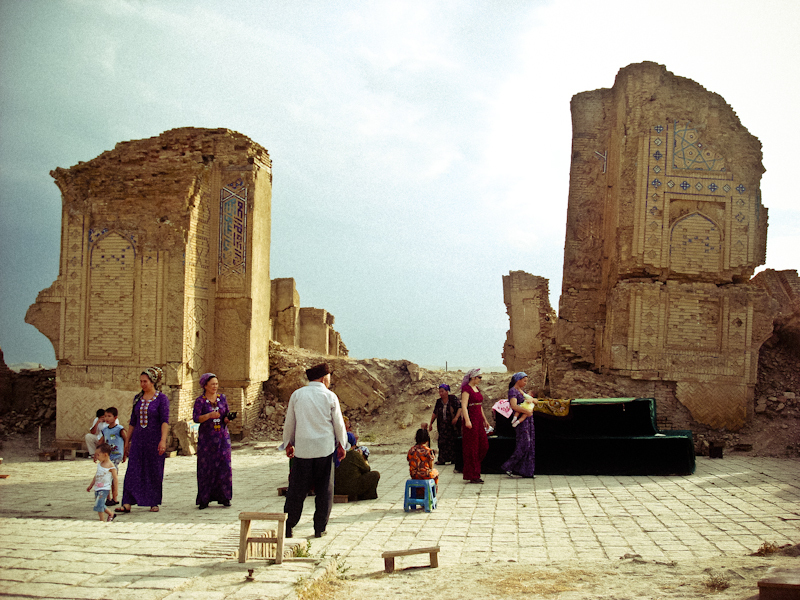
Documentary film, 17 min, 2012
Abstract:
The space afforded to customs allows for a lived religion, in which people seek to connect with the divine. The rites we have studied draw partly on an ancestral animism, which is better able to adapt to changing times than a dogmatised religion that seeks to halt the march of time. In Turkmenistan, these ritual practices constitute a significant social institution for a population under constant surveillance. The stance of the new Turkmen leader even appears today to rely on these traditional practices as a key element of the necessary distinctiveness of Turkmen identity, where Islam is relegated to the status of cultural heritage. In Uzbekistan, however, pressure from Islamist movements may, depending on the region, tend to force practitioners of pre-Islamic rites—or more precisely ‘peri-Islamic’ —into obscurity, given that their origins are not always known in terms of continuity. The prestige this country has gained through its role as the guardian of Islamic knowledge in Central Asia compels it to demonstrate a certain orthodoxy. It seems to us, however, that respect for customary rites through assimilation allows for a lived religion that is closer to Islam’s original spiritual mission than to the political and social role claimed for it by fundamentalists.
Carnet de recherche : https://pelerinsdasie.wordpress.com/